Thursday, March 14, 2013

Waka - Rowing the War Canoe

 
The Chief


The Chief's Grandson named Little Monster


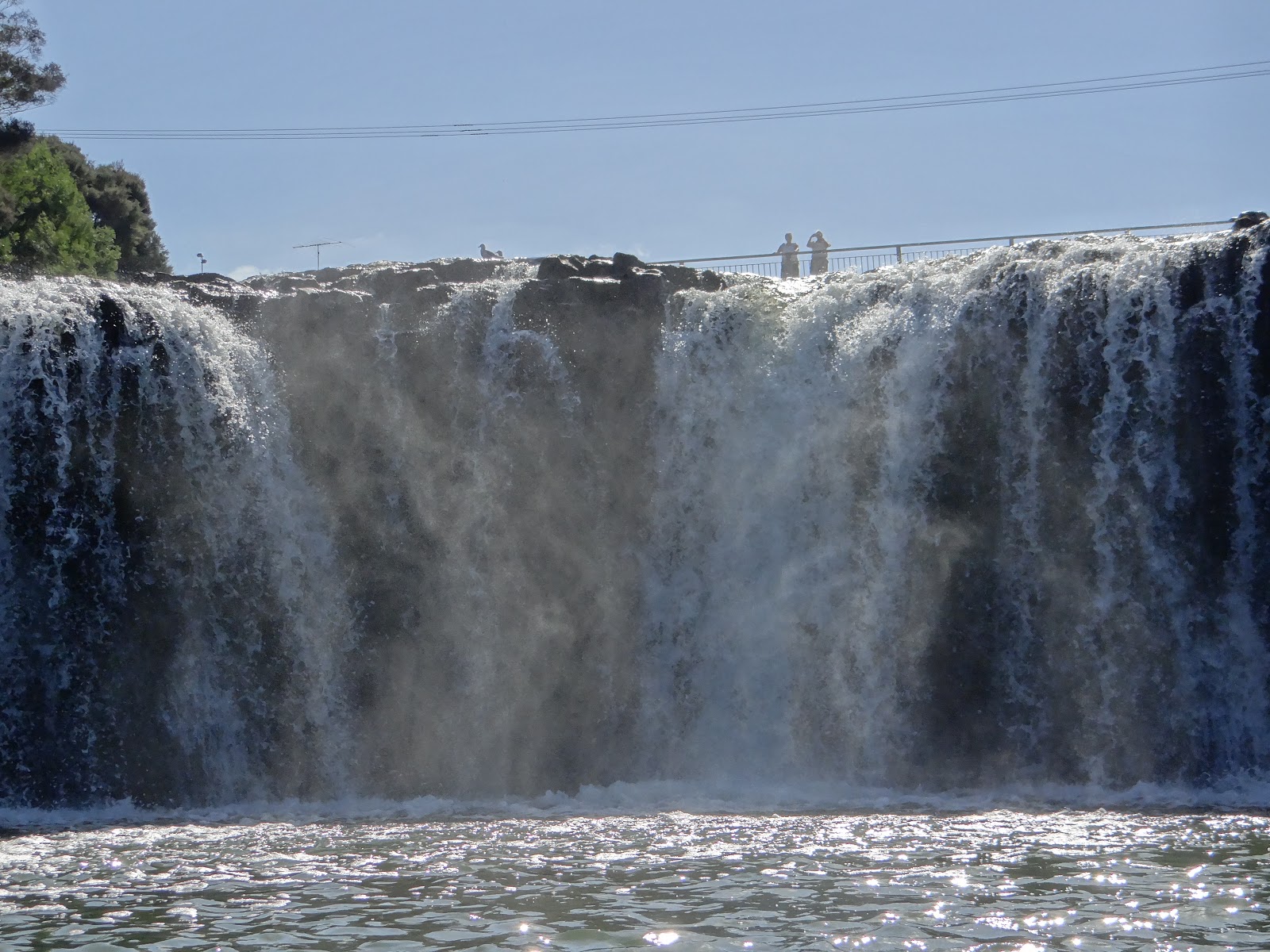
Rowing towards the waterfall
 
 
Our goal


The other canoe - we came in first.


Good Bye, Paihia.


NEW ZEALAND - The Bay of Islands


May we please leave the Asian countries with intense humidity for a while and go straight to New Zealand??? It’s like leaving the instant mashed potatoes and overcooked broccoli and going straight to the dessert.

I’ll write about Sydney when we go back there in a few days.

I awoke as we glided past islands and rocks large and small, sprinkled in the bay.  What a glorious day – brilliant sunshine, a breeze and cool enough to warrant a light jacket.  We anchored off the coast and could see small settlements around the bay.

The first announcement was that we had been given clearance to leave the ship and that customs officers would be waiting to check our bags for vegetation which might harm the delicate ecosystem of New Zealand – no food, not even cooked, only sealed bottles of water.

The next announcement was that the Chart Room and Sir Samuel’s bar were overflowing with passengers waiting for the tenders.  Oh, oh – tickets.  By the time I got a ticket, it was for tender number 34 and they had just called 18.  So I went back up to deck 7 and walked around the deck.  There I met Christine and Keith, English but living in Australia, for about the same amount of time as I have been in Europe. 

I judged the time correctly – it helped that I could count the tenders leaving – and got back when they were calling 31.   For a change, I sat in the open top of the tender and it was very smooth until we crossed the wake of a speed boat.  Then we rocked and rolled for about 30 seconds – wonderful!

If you remember last year, there is a Bay of Islands in Australia and while there, I went to Airlie Beach. It reminded me of a small California beach community.   New Zealand’s      Bay of Islands is even more beautiful.  Of course it helped that the weather has been perfect since Sydney.  Any rain fell in the middle of the night.

New Zealand – made up of 3 main islands - was the last land mass to be inhabited.  Polynesians first came to NZ before AD 1,000 and settled mainly on the North Island.  They probably numbered more than 200,000 until the arrival of European diseases and weapons.

Abel Tasman visited briefly in 1642 but was chased away by the Maoris but not before donating his name to Tasmania and the Tasman Sea.  James Cook visited also and apparently got along with the Maoris better than Tasman had.

Unfortunately for the Maoris, whaling was very profitable for the Europeans and a whaling station was the first noteworthy European settlement.  But, unfortunately for the moas, giant wingless birds (how dumb is that?), the Maoris like to hunt them, apparently to extinction.

Then, in 1840 there was the Treaty of Waitangi, or rather the treaties, between the British and 12 Maori clans:  one version in English and one in Maori.  In all probability, some things got lost in translation as fighting continued.

Despite occasional and some continuing disputes, Waitangi Day is celebrated in February and there is a memorial park, which is near the wharf where the tender docked at Paihia. 

The village was open for the tourists, even though it was a Sunday and the Post Office, which was not open, had a sign in the window telling us that we could get stamps at the stationary shop across the street.  And everyone I have encountered since then has been as friendly and helpful as that sign.

I bought postcards and sat in the sun writing some of them and licking the stamps from the stationary store and then dropping them in the box for overseas mail.  They should be there soon.

Paihia is a village strung around the bay, charming and friendly.  I bought earring from Penny Ryan (www.pennyryan.co.nz) who uses facebook to keep the “Chinese” from stealing her designs. Good for her!  And the earrings are beautiful.  Her stand was part of a local market, equally charming.

The Waitangi National Reserve has a collection of Maori weapons including a gun which belonged to Hone Heke Pokai, one of the signers of the treaty.  There is a magnificent Whare Runanga –meeting house – with carvings to represent the main Maori clans.

There is also an enormous canoe – 120 feet long, about 40 , which can carry 150 warriors – named Ngatokimatawhaorua.  Try saying that fast!  That was the name of the canoe in which Kupe discovered Aotearoa – the Land of the Long Cloud – New Zealand.

I had signed up for a tour, The Maori Adventure, which I assumed would involve watching a hake, a traditional greeting, perhaps some singing.  “Hello”, she said.  “My name is Judi and I am going to show you how to get your life vests on.”

Life vests??  Then, 3 semi-naked men appeared and pointed to paddles on the ground and the very long canoes being pushed up onto the shore.  Shades of Norway and the King Crab Safari.

The clan chief told us about the legends of the gods, that the word “Maori” mean “almost human” and that they call themselves te papa – the people.  He then had us form lines and tried to get one or 2 men into each line and handed each of us paddles.  One by one, we climbed into the canoes and, after a prayer by the chief, we tried to establish a cadence for paddling – “paddle and tap, paddle and tap, paddle and tap”.  That didn’t work at all but somehow we managed to leave the shore and travel more or less straight.  On the way we learned about some of the trees, shrubs and wildlife along the shore.  And, I managed to paddle the entire way to the waterfall – about 4 km.  We had the benefit of an outboard motor on the way back.  Another amazing adventure!

Then the chief asked if one of us would be willing to say a prayer.  Had I had the chance, I would have recited a poem/song learned years ago:

I am the mountain, I am the sky, I am the swallow, I fly and fly

I am the river, I nurse the land, I am the mountain, I am, I am

We’re bound together, this world and me, I am a part of all that I see

I am the river, I nurse the land, I am the mountain, I am, I am.


A most wonderful day followed by an evening (3 + hours) of dancing:  line dancing, sequence dancing, barn dances, English country dances and regular ballroom dancing.

Sometimes, it’s a lot of fun being me!
 

Sunday, March 3, 2013

Colombo


Colombo – this won’t take long


Sri Lanka has its own heat – absolutely searing.  As usual, we docked in the container terminal –heat-holding concrete.  We were told that because of the local taxi union, shuttle busses were not allowed.  We would have to walk to the terminal entrance and get local transport there.   The walk was about 35-40 minutes and after 15, despite my loose, all-cotton clothes, sweat was running down my face and back, really running – rivlets?  Whatever, it was totally icky!  ­­So, back I came and did my “shopping” at one of the stands on the dock, across from the ship. ­

Sangeeta, the World Voyage Concierge, had conducted a class on how to wrap a sari (or saree or sarie).  So, I bought one for the Oriental Ball the following evening.­­­­


Colombo has a natural harbor which was used by traders starting over 2,000 years ago – Greeks, Persians, Romans, Chinese and Arabs.  One of my heroes, Ibn Batuta, ca. 1304 – 1368, (see TRAVELS WITH A TANGERINE), who left home in Tangiers for a visit to Mecca and was gone 35 years, called Colombo “Kalanpu”.  Moslem Moor traders settled in Colombo in the 8th century and their descendants now comprise the local Moorish community.

 The earliest recorded inhabitants were Singhalese from Northern India, about 2,500 years ago.  Later, Dravidians invaded from Southern India – see where this is leading?  Ethnic tensions flared in the 1980’s when some of the Tamils in the north of Sri Lanka, perhaps urged on by the Tamils in Tamil Nadu, (southern India), agitated for a separate state.   Government forces fought the Tamil Tigers¸ the separatists, until May, 2009.

I am sure there are wonderful sights in and around Colombo but this was another case of an official warning about possible terrorist activity.  So, I saw it from afar, or as Baltimorians would say, “from a fire”.

Also, there are thousands of prisoners – mostly civilians – who happened to be in the wrong place at the wrong time – when the government army moved int.  Most apparently had no connections to the Tamil Tigers, at least no proven connection.

A factoid:  Sri Lanka is the 4th largest producer of tea, after …..OK, number. 1 is easy, China.  India is number 2 but can you guess which country is number 3???  No, I didn’t guess it either.  It’s Kenya.

Friday, March 1, 2013

Cochin/Kochi - February 2, 2013

To catch up:


According to legend, Kerala, the state and area of Cochin, was Christianized by St Thomas about 20 years after the crucifixion.  Kochi means a “small space” or “small lagoon” in Malayalam, the local language. 

Spices, especially pepper, cardamom and cloves, have always been important exports.  The first European settlement was by the Portuguese in 1500 and 3 years later, Vasco da Gama established a trading station.  From then on, it was a fight for the very lucrative spice trade.  The Dutch pushed the Portuguese out in 1663 and the British pushed the Dutch out in 1795.  They stayed until Indian independence in 1947.

Because of the travel advisory issued by Cunard, warning of  the´possibility of “extremist activity” in Cochin, complete with embassy telephone numbers, I had booked a tour, “Highlights of Cochin”. I must remember to look up the word “highlights”.  The telephone numbers would not have helped much since they were for the embassy in New Delhi, far, far away. 

The bus was frigid and the heat intense so the contrast was most unpleasant, matched only by the high-pitched voice of the tour guide and her annoying habit of bobbing her head from side to side when she talked.  She probably wonders why we don’t.

First to the museum with a grand total of 15 minutes visiting time.  Joseph, the caretaker of the museum, showed us a typical Cochin door lock which included symbols of the different religious communities peacefully co-existing in Cochin:  Hindu, Buddhist, Moslem, Syrian Orthodox, Syrian Catholic, Roman Catholic, Dutch Reformed, Confucianism.

From the museum, we were taken to the harbor for a walking tour.   This was a highlight:  the Chinese fishing nets.  Supposedly introduced by Chinese fishermen during the reign of Kublai Khan (1215-1294, the Yuan dynasty), these cantilevered nets are still in use.  A puzzle:  the blue crabs from the Chesapeake Bay are always cooked alive.  We were warned not to cook them after they had died.  However, at the Cochin market (temperature about 85° F in the shade), the crabs were arranged in a circle, very, very dead but for sale.

The “lowlight” of the tour:  a large building, divided into walled-off section, each containing a different luxury item:  furniture (“we ship all over the world”, jewelry (more expensive than on the ship), clothing (lovely, hand-embroidered exorbitantly expensive items) and any number of metal, wooden and plastic knick-knacks.  Total time there: 50 minutes.

From there we were driven to the Dutch Palace.  The more than 19 busses and 100 + cars in the parking lot gave me pause and well they should have.  When the Dutch ousted the Portuguese, they destroyed some of the maharajah’s buildings.  So, they built a mansion, called it a “palace” and everyone was, in theory, happy. 

We were one group out of about 10 and there were 3 or 4 “minders” for each group because photography was not allowed. The palace has carved teak ceilings darkened with age and so the interior was dreary, hot and humid.  It was Saturday so there were lots of families with hot, cranky children.  I left early but by the time I got out, the sun was directly overhead and it was brutal.

We drove to Jew Town, the non-politically correct name of a section of Cochin which was the Jewish Quarter.  There is still a synagogue but services were being held for the 8 practicing Jews left in Cochin.  We were dropped off at a spice market, also overcrowded, but when you think of it, what would most of the passengers on a ship do with bags of spices?

I walked around the side and back streets, successfully avoiding the merchants who popped out of their shops as I approached.  One appeared so suddenly that I let out a little (maybe not so little) shriek which naturally brought other shopkeepers out.  Oh, joy!  I was not sorry to be back on the ship.


Tuesday, February 26, 2013

Where we are

Tuesday, 26 February 2013


Ladies and Gentlemen, Boys and Girls, start your atlases:


we are

150 miles south of Yap

260 miles west of the Caroline Islands

deep in Micronesia, where people have hair like mine.

Depth under the keel = 3,660 meters or about 12,000 feet

As I write this, we have force 5 winds (breezy but you can stand upright) and have just come through a squall - very heavy rains and high winds.

The Equator sends its greetings.


While you are at it, check out the weather forecast for Northern Australia.  We are on the way to Cairns.

Saturday, February 23, 2013

Dubai and Abu Dhabi


We were in Dubai for 2 days and the end of the first day was spent saying farewell to new acquaintances and friends.  Unfortunately, I had 3 appointments for the same time.  As you can tell, my memory is still not what it was before the accident and it’s imperative that I make a note and post it prominently.

On the second day, I took the shuttle bus to the Burjuman shopping center.  As I got on the bus, I met Mark who asked where I was going.  When I said the aquarium, he said that he was on his way there, too.  So, we travelled together.  He is a cheerful travelling companion – very funny, thoughtful and quiet at the right times. 

The “strip malls” along the way into town – the ground floor of offices and/or apartment buildings – had every American (1 Canadian = Tim Horton’s) fast food joint – KFC, Pizza Hut, Burger King, IHOP (I think) and of course, McD.

On the bus, I was lectured by a complete stranger about the wonders of the Metro – a form of transport I had not intended to use.  Mark, however, was convinced of the ease and efficacy, and after changing money at the top of the clean, clean, clean Burjuman over an endless supply of clean, clean, clean escalators, we headed out to the Metro station, also clean, clean, clean.  Day passes were about €3 / $4.

The metro is un-manned which un-nerved me at first but it was clean, actually clean and polished:  no trash (rubbish to some of you), no graffiti – none!, no plastic bits blowing into the corners – nothing, nada!   And, in about 10 minutes we arrived at the Burj Khalifa station, with a covered walkway to the mall. 

Once inside, after a long walk on moving sidewalks – go figure! – we got to the entrance of the mall, an enormous archway, very glitzy.  Just ahead of us was a young couple with a baby:  the man, about 25, dressed in deliberately worn jeans, Nike trainers, a tan, very expensive leather jacket¸someone at home in London or NY and his wife/sister dressed completely in black, with slits for her eyes, fashion-wise really only at home here, Saudi Arabia or Yemen.  I wonder if she can read and write and if the daughter she was holding will also be veiled.

The Burj Khalifa, the tallest building in the world, has an enormous mall with a gazillion shops at its base.  Most of the shops are well-known chains stores:  Gap, Banana Republic, Mango, Sony, Virgin Records, Sephora, and the upscale stores including Saks 5th Avenue and Bloomingdales.

We walked in the direction of the aquarium, window shopping along the route – “look at all that gold”, checked out a jacket for me at Gap and a knitted jacket for him.  I visited the tourist “souk” inside the mall – a really silly idea but air conditioned.

When we got to the enormous aquarium Mark was rather blasé about it but I dragged him in past the giant windows into the tunnel where we stood surrounded on 3 sides by giant rays, sharks (one of which had a bit of flesh or thong dangling from his front teeth) and other fish which manage to live with the sharks.  For me, the rays were the most amazing – easily the width of my outstretched arms with the grace which belies their strength.  We were there for almost an hour, standing still, “ooh-ing and ahh-ing”, look up, look behind you, look at that!!!”

Abu Dhabi is like a restrained Dubai.  Perhaps that is why they were able to help Dubai financially – they did not overspend.  There is a beach, all along the road from the container terminal into the city and lots of trees and very green grass.  But, I never saw anyone swimming.  I did some shopping at the Carrefour (paper towels, post cards, contact lens solution, Pear’s soap) and hurried back to the ship.  Enough of oil money excess!

Friday, February 22, 2013

Shanghai, well not really


Last year, due to the ad hoc nature of my voyage, I did not have a visa for China so was confined to the ship.  This year, I first got the visa for India knowing that I would not be allowed on the ship without it.  And, then simply ran out of time as I did not want to give up my passport so close to the departure date.

So I called Cunard in Southampton, spoke to a lovely man who said that the pursers would get it for me on the ship.  He said that I should ask them as soon as I boarded in Southampton and they could apply in the UK, and it could be picked up on the return in January or it could be applied for in Dubai and picked up in Hong Kong.

I got on the ship, asked the pursers and no one had a clue.  So, the visa was never applied for and I am not allowed off.  There are worse things.  None of the American crew members is allowed off, but there are so many different stories about why that no one knows which to believe.

What I found interesting was a notice that China will not allow anyone who is coughing to enter and if caught in China, that person will be quarantined.  The word comes from Italian – quarantigioni – which means 40 days.  When the plague swept through Europe in the 14th century, the Venetian Republic required ships to anchor away from the city and not unload for 40 days – enough time for the disease to be cured or for the sailors to die.  Forty days in a Chinese hospital jail – oh joy!

All ships under quarantine had to fly a yellow flag – a rule still in force today.  According to the daily program, a yellow flag is still carried aboard QM2.

During the Christmas holiday voyage, with the many cases of Norovirus aboard, there were fears among some of the passengers that the ship would not be able to dock in New York.  Let’s see – quarantine aboard ship, quarantine in a Chinese jail, quarantine aboard ship, quarantine in a Chinese jail – duh!!

Aside from the obvious of not wanting to do anything in a Chinese jail, an incident yesterday morning convinced me that I really do not want to do anything in China.

While walking through the Grand Lobby yesterday morning, I encountered a group of Chinese visitors, in their 20’s, dressed in blue uniforms with beautifully embroidered letters and characters on the back of their jackets.  I asked if I could photograph the characters and a young man graciously assented.  As I did; I noticed a “minder” photographing me so I then photographed him photographing me photographing him.  This could have gone on for hours – actually it did for 3 rounds of photographs but then the head minder, in a dark blue suit barked what sounded like an order and they all left, two by two.  The photo I took will end up on the blog.  What do you suppose will end up with the photo of me?  Yeh, I think so, too.


PS:  I know there are some stops missing and I will fill in the gaps starting tomorrow.  We will have 6 or 7 sea days – my favorite.